
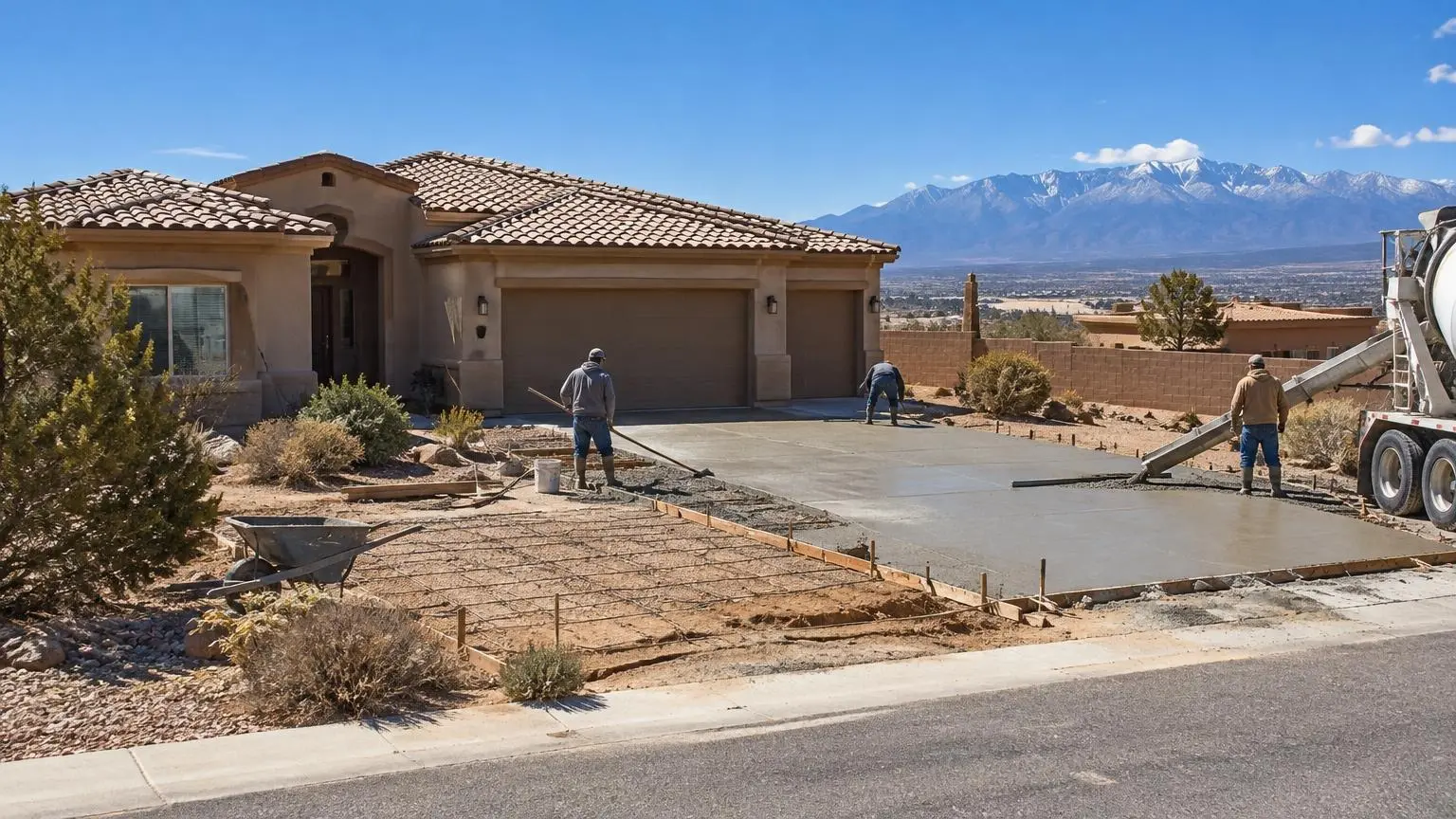
Replacement, widening and RV parking
Concrete Driveways in Rio Rancho, NM
Sized for what you park, pitched for monsoon runoff, and cured with the mesa sun in mind.
- Estimate visits start with the ground: grade, runoff and what sits under the old slab
- Quotes broken into lines for area, depth, base, steel, finish and sealer
- Pour dates picked around mesa heat in summer and below-freezing nights in winter
Driveways Start Below the Surface
Concrete driveways in Rio Rancho carry more than cars. Each one also handles roof and street runoff, July afternoons in the mid-90s at about 5,500 feet, and winter nights near freezing. A large share of the city's homes went up in the 1980s, 1990s and 2000s, so plenty of original drives now have a split garage apron, a corner that has dropped, or simply not enough width for the vehicles a household owns today.
When replacement is on the table
These are the conditions that usually push a driveway toward a new pour:
- Cracks that have opened past roughly a quarter inch, or that get longer every year
- Panels that have sunk and now catch water or catch toes
- Edges crumbling where tires roll off the side
- Wide patches of scaling, where the top layer has peeled away
- A layout that no longer fits your vehicles
A single broken panel in an otherwise solid drive is a different case. Cutting out that one section and pouring a new one tied to its neighbors can be the smarter spend, and we will say so.
Five things that decide how long it lasts
Ground prep. The old slab and any soft or organic soil come out, and a gravel base goes down in compacted lifts. On ground that may settle after a soaking, a solid base and good drainage are worth more than extra concrete on top.
Depth. According to HomeGuide's driveway cost guide, standard vehicles need at least 4 inches, while RVs and heavy loads call for 5 to 6 inches with edges of 6 to 8 inches. If a camper, trailer or work truck lives on your drive, the design accounts for it.
Steel. Rebar or mesh keeps the two sides of a crack at the same height. Where new concrete meets a slab we are keeping, dowels lock the two together.
Pitch and joints. Water should run toward the street, never back into the garage. Control joints are sawn on a planned grid so the inevitable shrinkage cracks land in straight, tidy lines.
Cure and seal. Summer pours start early, and a curing compound or wet cure goes on as soon as finishing ends. After the slab has cured, a penetrating sealer cuts down on water uptake, freeze damage and oil stains.
Extra width and RV parking
Many lots here have space along the drive for another car, a boat or a travel trailer. That can be an extension pinned to the existing slab with dowels, or a separate pad with its own joint pattern. Either way, heavier vehicles need more depth and a well-compacted base, and the new concrete should follow the fall of the old drive so no puddle forms at the seam.
Curb cuts and HOA approval
Changing where a driveway meets the street, or crossing a public sidewalk, can bring in the City of Rio Rancho or the county, depending on your address. We look that up before anything is scheduled. Many HOAs here also want to approve width or finish changes, and we can supply a dimensioned sketch and specs for that submission.
Line Items on a Driveway Quote
Every driveway estimate breaks the job into these pieces, so two bids can be compared fairly.
Demolition and hauling
Breaking out the existing drive or apron and trucking the rubble off the property.
Subgrade and gravel
Cutting to an even depth, digging out weak soil, and compacting crushed gravel underneath.
Forms, pitch and steel
Forms set for a steady fall to the street, rebar or mesh placed, and dowels drilled into any slab staying in place.
Surface finish
Broom texture for grip as standard, with exposed aggregate or a decorative border as options.
Joint layout and cure
Saw-cut control joints on a planned spacing, with curing begun on pour day.
Side pads and RV parking
Thicker add-on slabs pinned to the existing drive and matched to its fall.
Typical Concrete Driveway Costs
| Item | Published range |
|---|---|
| Standard installed driveway (per sq ft) | $6 to $10 |
| One-car, 12' x 24' (288 sq ft) | $1,700 to $4,300 |
| Two-car, 20' x 20' (400 sq ft) | $2,400 to $6,000 |
| Two-car, 24' x 24' (576 sq ft) | $3,500 to $8,600 |
| Three-car, 24' x 36' (864 sq ft) | $5,200 to $13,000 |
| 6-inch slab for heavy vehicles (per sq ft) | $8 to $20 |
| Old driveway removal (per sq ft) | $2 to $6 |
| Rebar reinforcement (per sq ft) | $1 to $3 |
National ranges from HomeGuide's concrete driveway cost guide. Rio Rancho prices depend on tear-out, access, thickness, finish and what we find under the old slab. Your written estimate is the price.
Driveway Job, Step by Step
1. Site visit
Measurements, a layout sketch, a check of the fall toward the street and a talk about what gets parked there.
2. Break-out and base
Old concrete is removed, weak soil dug out, and crushed gravel compacted in place.
3. Forming
Forms are set and checked for pitch, steel is placed, and dowels pin into concrete we are keeping.
4. Pour day
Concrete is placed at a time chosen for the weather, finished, sawn at the joints and put under cure.
Concrete Driveways Questions
How thick should a driveway be in Rio Rancho?
For ordinary cars, 4 inches is the floor. HomeGuide's guide suggests 5 to 6 inches for RVs and other heavy vehicles, with thicker edges. Tell us about any trailer, camper or work truck and we will design the depth and base around it.
When can I park on a new driveway?
Foot traffic is generally fine within a day or two. Give it roughly a week before a car goes on it, and longer before anything heavy. Strength keeps building for about four weeks, and we hand you specific dates for your slab.
Is it better to repair or replace my driveway?
Narrow cracks in a slab that is still level can often be sealed, or one panel swapped out, for years of extra use. Wide cracks, sunken sections, standing water or scaling across much of the surface usually make a new driveway the better value. When both options are reasonable, we price both.
Should a new driveway be sealed?
It is optional but worthwhile here. A penetrating sealer slows how much water soaks in, which means less flaking after winter freezes and fewer stains. It goes on once the slab has cured, usually about a month after the pour.
Concrete Driveways Service Areas
- Concrete Contractors in Rio Rancho, NM
- Concrete Contractors in Corrales, NM
- Concrete Contractors in Bernalillo, NM
- Concrete Contractors in Albuquerque, NM
- Concrete Contractors in Placitas, NM
- Concrete Contractors in Los Ranchos de Albuquerque, NM
- Concrete Contractors in North Valley, NM
- Concrete Contractors in Paradise Hills, NM
- Concrete Contractors in Sandia Heights, NM
- Concrete Contractors in West Mesa, NM
- Concrete Contractors in Nob Hill, NM
- Concrete Contractors in Old Town Albuquerque, NM
- Concrete Contractors in Downtown Albuquerque, NM
- Concrete Contractors in Barelas, NM
- Concrete Contractors in South Valley, NM
- Concrete Contractors in Huning Highlands, NM
- Concrete Contractors in Fourth Ward, NM
- Concrete Contractors in International District, NM
- Concrete Contractors in Mesa del Sol, NM
- Concrete Contractors in Algodones, NM
Get a Concrete Driveways Estimate
Free on-site estimates for driveway replacement, widening and RV parking in Rio Rancho and the surrounding area.