
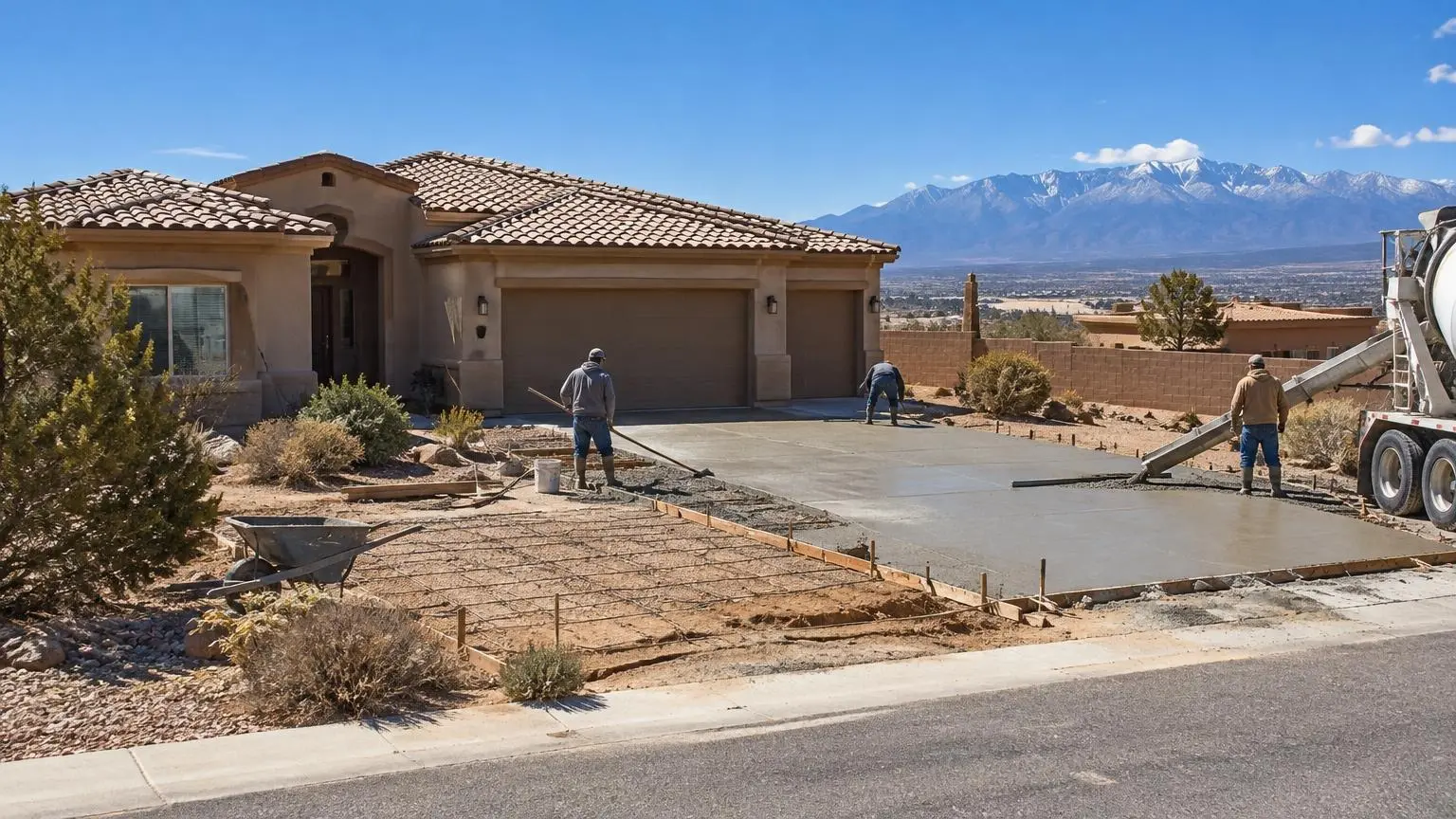
Mostly built between 1925 and 1950
Concrete Contractors in Nob Hill, NM
Careful flatwork for homes that have stood for close to a century, east of the university.
- Estimate visits start with the ground: grade, runoff and what sits under the old slab
- Quotes broken into lines for area, depth, base, steel, finish and sealer
- Pour dates picked around mesa heat in summer and below-freezing nights in winter
Nearly a Century of Sidewalks
Nob Hill sits just east of the University of New Mexico, between Lomas Boulevard, Washington Street, Zuni Road and Girard Boulevard, and its concrete is some of the oldest that concrete contractors in Albuquerque work on. Most of the neighborhood was built between about 1925 and 1950, as the city grew east along Central Avenue. Many of the walks, steps and driveway strips here have been in place for decades longer than anything in Rio Rancho.
The subdivisions behind the name
Nob Hill is really a cluster of early additions. University Heights was platted in 1906 and began filling in during the late 1920s. Granada Heights followed in 1925, Monte Vista in 1926, College View the same year and Mesa Grande in 1931. Wikipedia notes that more than 100 houses had been built in the Monte Vista Addition by 1930, and that its streets follow an irregular pattern shaped by the land and its drainage.
Those winding streets are worth noticing. They follow the natural fall of the mesa, so some lots slope toward the house or the side yard. When we replace a walk or a driveway here, we check where water wants to go and make sure the new concrete sends it the other way.
Historic districts and what they mean for you
Nob Hill has four historic districts on the National Register. Monte Vista and College View were listed together in 2001, Broadmoor Addition and Granada Heights in 2022, and University Heights in 2025. National Register listing by itself mostly recognizes a place's history, but if your home also falls under a local historic overlay or review, changes visible from the street may need approval. We check before we propose anything that changes how the front of the property looks.
Old concrete, honest assessment
Concrete from the 1920s through the 1940s was often poured thinner than today's standard, without steel and on a base that was never compacted the way we would now. After many decades it usually shows:
- Heaved or sunken panels in front walks, often near street trees
- Crumbling step edges and worn treads on entry steps
- Narrow driveway ribbons or short drives built for smaller cars
- Layers of patches where previous owners fixed one problem at a time
Sometimes the right answer is to replace a few sections and keep the rest. Sometimes the whole walk has reached the end of its life. We walk the property with you and explain which is which.
Keeping the character
The charm of a neighborhood like this is that it looks like it has been there for a while. Bright new gray concrete next to a 1930s house can look out of place. Options we use here:
Matching widths. New walks and steps at the original dimensions, rather than oversized modern ones.
Tinted concrete. A light color to soften the contrast with older surfaces.
Traditional finishes. A simple broom or smooth-troweled surface with tooled edges instead of busy stamped patterns at the front.
Stamped concrete out back. In the backyard, a stamped flagstone patio fits many owners who want an outdoor room without changing the street view.
Working in tight urban lots
Nob Hill lots are small and often close to the street, with alleys behind some blocks. Access, parking and protecting neighbors' property all take planning. We work out where the truck will go, how concrete will reach the back, and where old concrete will be stockpiled before we haul it away. Work in the public sidewalk or a curb cut falls under the City of Albuquerque, and we check those requirements before scheduling.
Nob Hill History in Concrete Terms
- When it was built. Most of Nob Hill was developed between about 1925 and 1950 as Albuquerque grew east along Central Avenue.
- Early additions. University Heights (1906), Granada Heights (1925), Monte Vista and College View (1926) and Mesa Grande (1931).
- Historic districts. Four National Register districts, listed in 2001, 2022 and 2025, cover much of the neighborhood.
- Terrain-shaped streets. Monte Vista's irregular streets follow the topography and drainage, and over 100 houses stood there by 1930.
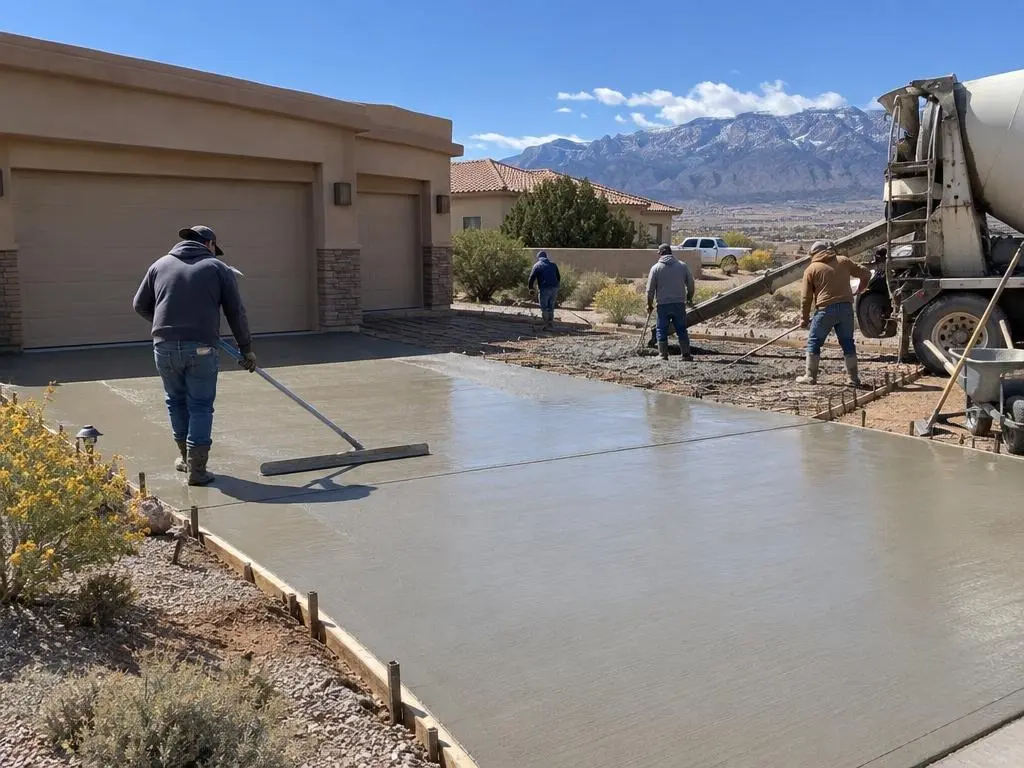
Our Services in Nob Hill, NM
Nob Hill Questions
Can new concrete match the look of my 1930s front walk?
We can get close. We match the original width and edge detail, use a simple traditional finish and can tint the mix slightly so it does not look stark next to older concrete.
Do I need approval to replace a walk in a Nob Hill historic district?
It depends on your property and any local overlay. National Register listing alone usually does not restrict homeowners, but local review can. We check before proposing changes visible from the street.
Why do Nob Hill walks heave near the street?
Often tree roots, plus decades of water getting under thin, unreinforced concrete. We look at the cause before recommending repair or replacement.
Free Estimates in Nob Hill, NM
Free estimates for Nob Hill homes, from Monte Vista to University Heights.
Concrete Contractors Near Nob Hill
- Concrete Contractors in Rio Rancho, NM
- Concrete Contractors in Corrales, NM
- Concrete Contractors in Bernalillo, NM
- Concrete Contractors in Albuquerque, NM
- Concrete Contractors in Placitas, NM
- Concrete Contractors in Los Ranchos de Albuquerque, NM
- Concrete Contractors in North Valley, NM
- Concrete Contractors in Paradise Hills, NM
- Concrete Contractors in Sandia Heights, NM
- Concrete Contractors in West Mesa, NM
- Concrete Contractors in Old Town Albuquerque, NM
- Concrete Contractors in Downtown Albuquerque, NM
- Concrete Contractors in Barelas, NM
- Concrete Contractors in South Valley, NM
- Concrete Contractors in Huning Highlands, NM
- Concrete Contractors in Fourth Ward, NM
- Concrete Contractors in International District, NM
- Concrete Contractors in Mesa del Sol, NM
- Concrete Contractors in Algodones, NM