
About five degrees warmer than the Sunport by day
Concrete Contractors in North Valley, NM
Flatwork for 4,850 homes in the valley, where summer heat and monsoon rain both hit concrete hard.
- Estimate visits start with the ground: grade, runoff and what sits under the old slab
- Quotes broken into lines for area, depth, base, steel, finish and sealer
- Pour dates picked around mesa heat in summer and below-freezing nights in winter
Hot Days, Hard Rain, Low Ground
The North Valley is the unincorporated stretch of Bernalillo County north of central Albuquerque, along the Rio Grande, and it is one of the closest valley areas to Rio Rancho. For concrete contractors, its weather is what sets it apart. Wikipedia notes that summer days often reach 100 degrees and that daytime temperatures run about five degrees warmer than the Albuquerque Sunport. The 2020 census counted 11,149 residents and 4,850 housing units on about 7 square miles.
Pouring in the heat
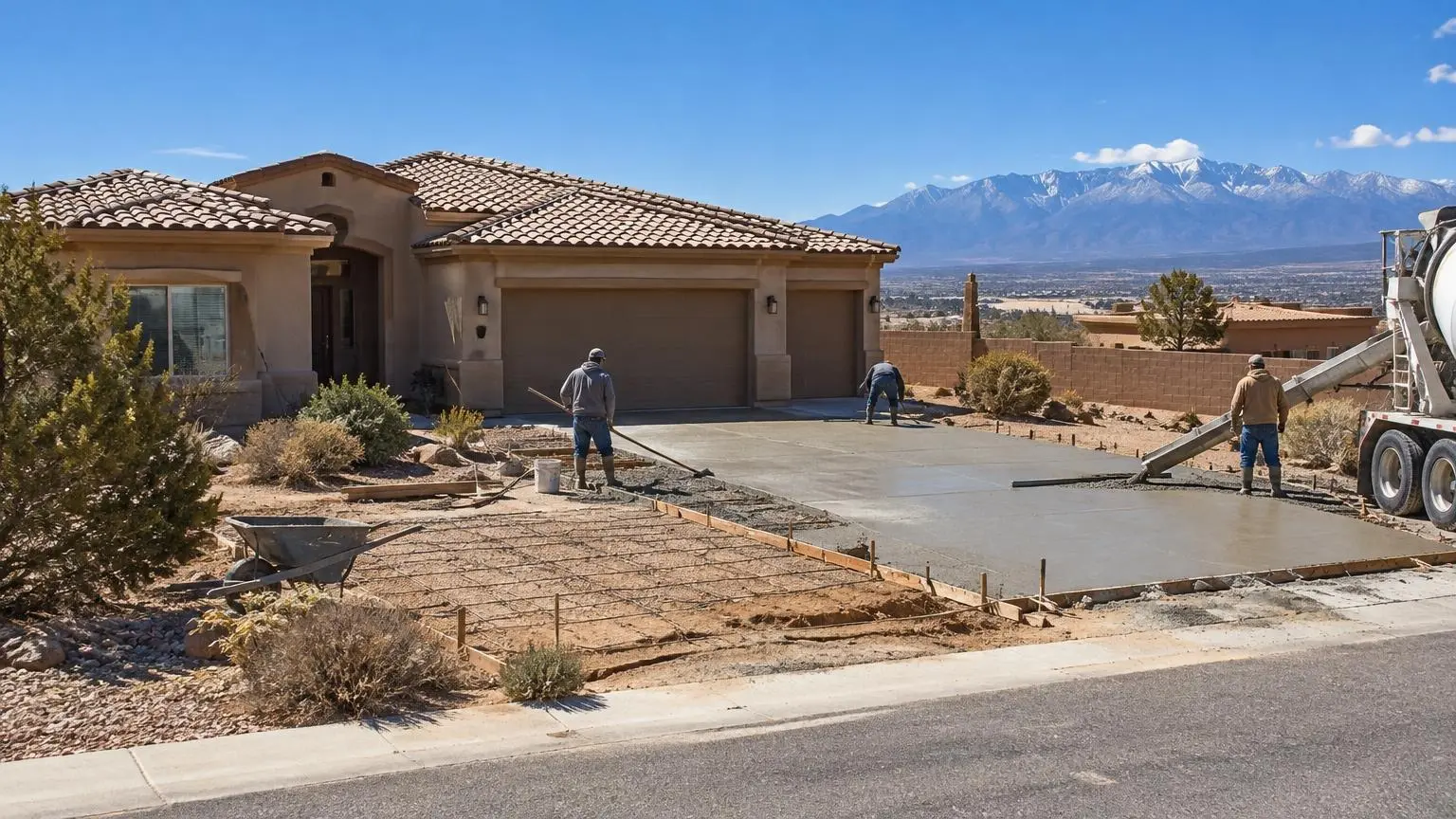
High heat is one of the hardest conditions for fresh concrete. Water leaves the surface fast, which can cause plastic shrinkage cracks before the slab has even set, and a hot slab can set before finishers are ready. In the North Valley summer we:
- Schedule pours for early morning
- Dampen the base and forms so they do not pull water out of the mix
- Have the crew and tools ready before the truck arrives
- Start curing as soon as finishing is done, with a curing compound or wet cure
None of that is visible after the job, but it is often the difference between a slab with random cracks and one that only cracks at the joints.
Monsoon season
The North Valley averages only about 6.75 inches of precipitation a year, but the monsoon, which usually starts in late June or early July and can run to mid or late September, delivers much of it in short storms. A storm is the worst thing that can happen to a slab poured the same afternoon, so we watch forecasts closely and keep plastic on hand. Over the longer term, monsoon runoff is what undermines patios and walks, so we pay attention to slope, downspouts and where water leaves the lot.
Cold extremes too
For all its heat, the area has seen a record low of minus 19 degrees. Snow is light, averaging about 3.7 inches a year, but nights below freezing are common in winter. Air-entrained concrete, which holds tiny air bubbles that give freezing water room to expand, is standard for our exterior work for this reason.
A view from the yard
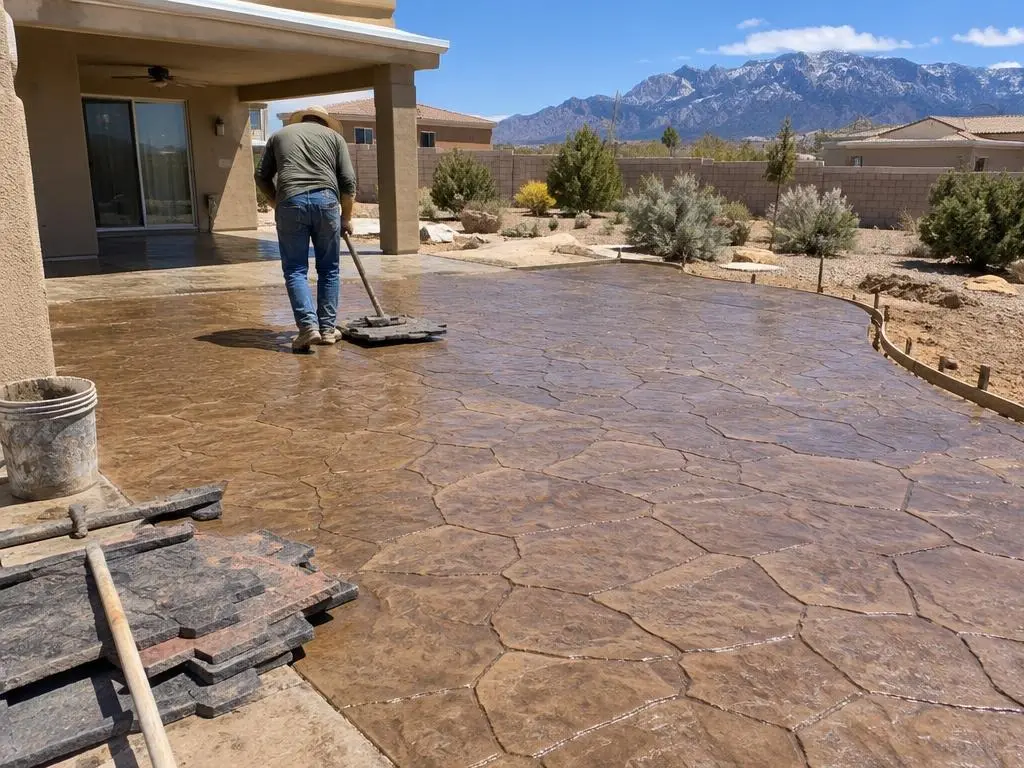
Wikipedia notes that Balloon Fiesta can be watched from yards anywhere in the North Valley. Plenty of homeowners here want a patio built for exactly that: a wider slab facing the sky, a stamped finish, room for chairs and maybe a fire pit. For patios like this we discuss size, which way the slab faces, shade, and how the edge transitions to the yard.
Work we do in the North Valley
Driveway replacement. Many valley homes have older drives that have settled or cracked into pieces.
Patios and extensions. Adding space to small slabs, with a light-colored finish that stays cooler underfoot.
Stamped concrete. Patterns that suit adobe and ranch-style homes.
Walkways. Front walks, side paths and garden routes.
Slabs. Sheds, carports and trailer pads on larger lots.
Repair. Crack sealing, leveling and section replacement.
Because the North Valley is unincorporated county land next to the City of Albuquerque and the Village of Los Ranchos, which rules apply depends on your exact address. We check before we schedule.
Bigger lots than the mesa subdivisions
The numbers show how spread out the North Valley is. Its 11,149 residents live on about 7 square miles, roughly 1,600 people per square mile, against more than 4,200 per square mile in Paradise Hills up on the mesa. More ground per house usually means longer driveways, room for a detached shop or carport slab, and more irrigated yard next to the concrete. On those lots we plan the base and edges for ground that stays damp longer, and we keep sprinkler and garden water from running onto the slab.
North Valley Climate and Housing
- Hotter days. Summer days often hit 100 degrees, and daytime temperatures run about five degrees warmer than the Albuquerque Sunport.
- Monsoon timing. The monsoon usually starts in late June or early July and can last into mid to late September.
- Dry overall. Average annual precipitation is about 6.75 inches with roughly 3.7 inches of snow; the record low is -19 degrees.
- Housing. The 2020 census counted 4,850 housing units and 11,149 residents on about 7 square miles.
Our Services in North Valley, NM
North Valley Questions
Can you pour concrete in the North Valley in July?
Yes, with care. We pour early in the morning, dampen the base and start curing right away so the surface does not dry too fast in the heat.
What if a monsoon storm hits right after a pour?
We watch the forecast and keep plastic sheeting ready to cover fresh concrete. If a storm looks likely, we reschedule rather than risk the surface.
Is a lighter color patio cooler?
Generally, yes. Lighter colors absorb less sun than dark ones, which makes a noticeable difference on summer afternoons in the valley.
Free Estimates in North Valley, NM
Free estimates across the North Valley.
Concrete Contractors Near North Valley
- Concrete Contractors in Rio Rancho, NM
- Concrete Contractors in Corrales, NM
- Concrete Contractors in Bernalillo, NM
- Concrete Contractors in Albuquerque, NM
- Concrete Contractors in Placitas, NM
- Concrete Contractors in Los Ranchos de Albuquerque, NM
- Concrete Contractors in Paradise Hills, NM
- Concrete Contractors in Sandia Heights, NM
- Concrete Contractors in West Mesa, NM
- Concrete Contractors in Nob Hill, NM
- Concrete Contractors in Old Town Albuquerque, NM
- Concrete Contractors in Downtown Albuquerque, NM
- Concrete Contractors in Barelas, NM
- Concrete Contractors in South Valley, NM
- Concrete Contractors in Huning Highlands, NM
- Concrete Contractors in Fourth Ward, NM
- Concrete Contractors in International District, NM
- Concrete Contractors in Mesa del Sol, NM
- Concrete Contractors in Algodones, NM