
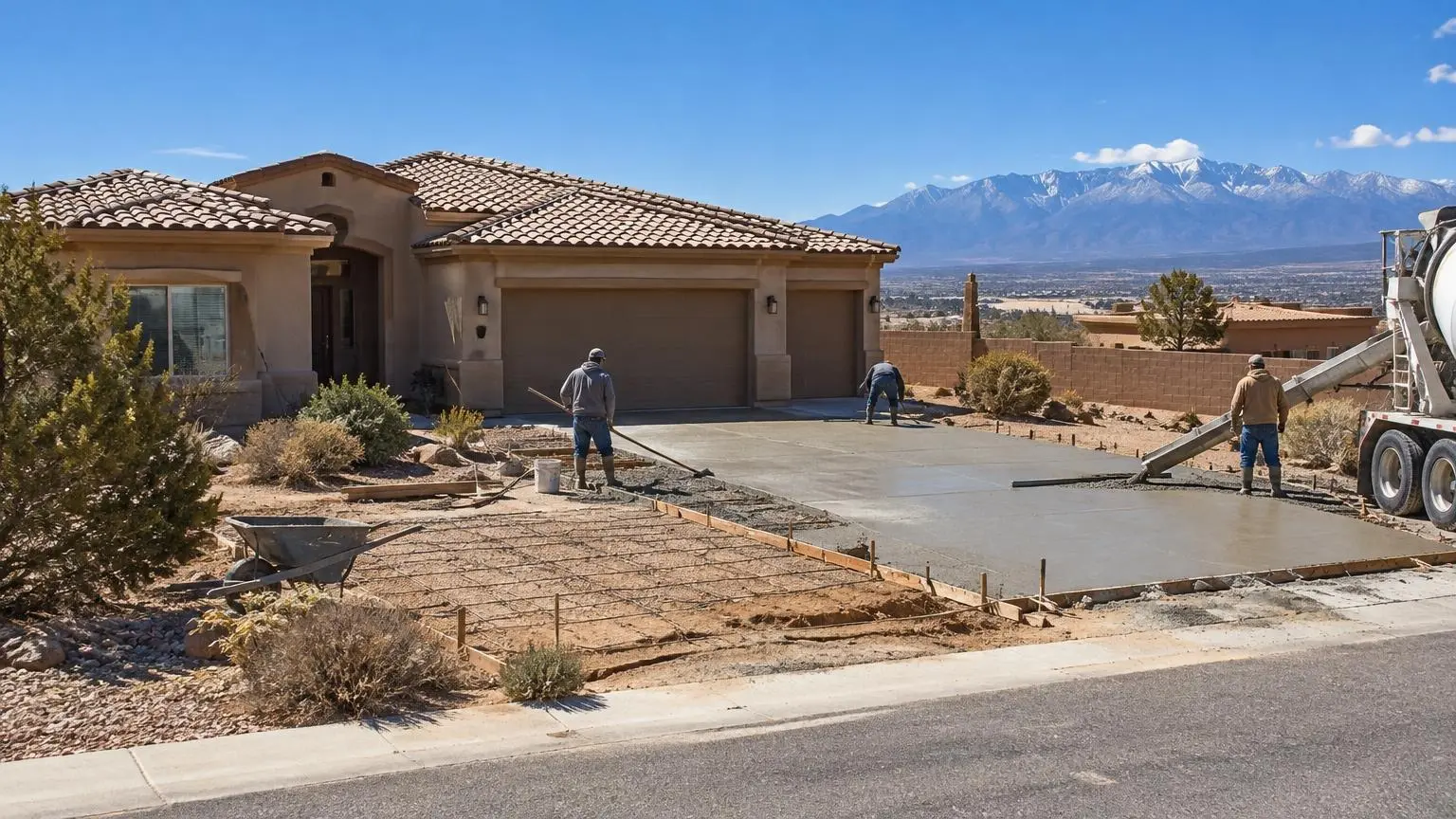
Founded in 1706, paved for the first time after 1949
Concrete Contractors in Old Town Albuquerque, NM
Careful, low-key concrete work around adobe walls in one of the oldest parts of the metro.
- Estimate visits start with the ground: grade, runoff and what sits under the old slab
- Quotes broken into lines for area, depth, base, steel, finish and sealer
- Pour dates picked around mesa heat in summer and below-freezing nights in winter
Concrete Around Adobe Walls
Old Town Albuquerque is the historic core of the city, about ten blocks of adobe buildings around the plaza, and the work concrete contractors do here is different from anywhere else in the metro. The town was established in 1706, and most of its historic buildings date to between 1870 and 1900. The district covers about 0.8 square miles, bounded by Rio Grande Boulevard, Mountain Road, 19th Street and Central Avenue.
Paving came late
One detail on Old Town's Wikipedia page explains a lot: the area did not get paved streets and sidewalks until Albuquerque annexed it in 1949. Before that, people walked on dirt. So any concrete you see here is, by the standard of the buildings around it, a recent addition, and much of it has been patched and replaced many times since.
That history means the base under older Old Town walks can be anything: old fill, packed earth, broken brick. When we replace a section, we dig it out properly and build a compacted gravel base, because pouring fresh concrete on what was there before is how the same section ends up cracked again.
Adobe and water do not mix
Adobe walls are earth. Water splashing against them or soaking the ground at their base can erode the wall over time. That makes the concrete next to an adobe building more important than it looks:
- Slope away from the wall. Every walk, patio and courtyard should drain away from the building.
- No splash back. Downspouts and canales should discharge onto a surface that carries water off, not against the wall.
- A gap or flexible joint between concrete and the adobe wall, so the two can move independently.
- No trapped moisture. We avoid pouring concrete right up against the base of an earthen wall in a way that holds water there.
Protected district, careful choices
The area is listed on the New Mexico State Register of Cultural Properties as the Old Albuquerque Historic District, and the city protects it with special historic zoning. Several homes nearby are on the National Register, including the Salvador Armijo House from around 1840 and the Antonio Vigil House from 1879. Changes visible from the street can be reviewed, so color, finish and layout matter. We check what review is required and suggest finishes that fit: earth-toned integral color, simple broom or hand-troweled surfaces, and clean tooled edges rather than flashy patterns.
Courtyards and back patios
Inside walls and behind buildings, there is more freedom. Courtyards are a natural fit for Old Town architecture, and a stamped flagstone or tile pattern in warm tones can look right at home. We pour courtyard slabs at 4 inches with steel, slope them toward a drain or an opening, and plan around trees, planters and fountains.
Small jobs are normal here
Old Town work is often small: a set of entry steps, a single walkway section, a threshold, a short ramp, a patch of courtyard. We are comfortable with small jobs and give them the same care as large ones. Lots and streets are tight, so we plan truck access, use smaller loads or a buggy where needed, and keep the work area tidy for neighbors and visitors.
Repair before replacement
If an older walk can be saved by replacing one or two sections, we will say so. In a historic setting, keeping sound concrete in place is often the better choice for both cost and character.
Winter on the plaza blocks
In Old Town, shaded courtyards between thick adobe walls can hold frost long after the street has thawed. That is hard on concrete. Water that soaks into a porous surface freezes overnight, expands and flakes the top layer off a little more each winter. For Old Town work we use an air-entrained mix, cure it properly so the surface reaches full strength, and recommend a breathable penetrating sealer rather than a glossy film that can trap moisture. A light broom texture also gives better footing on a cold morning than a slick trowel finish.
Old Town Facts That Affect Concrete
- Late paving. Old Town got paved streets and sidewalks for the first time after Albuquerque annexed it in 1949.
- Building age. About ten blocks of historic adobe buildings surround the plaza, most built between 1870 and 1900.
- Historic zoning. The Old Albuquerque Historic District is on the state register, and the city protects it with special historic zoning.
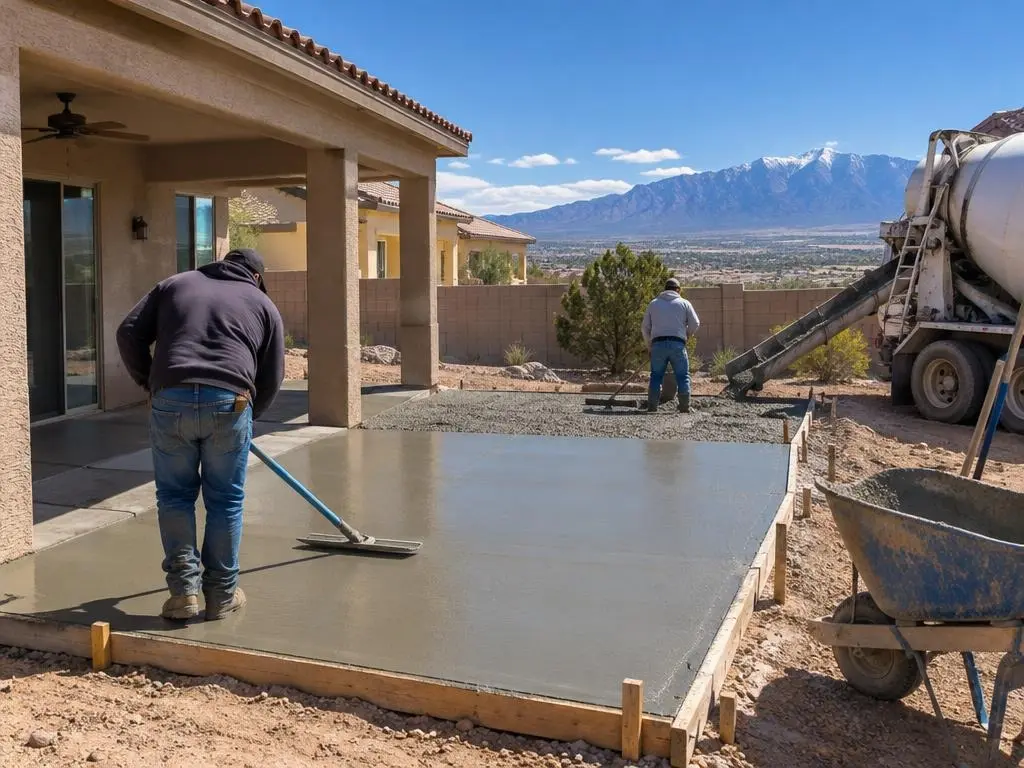
Our Services in Old Town Albuquerque, NM
Old Town Albuquerque Questions
Can concrete damage an adobe wall?
Concrete that sends water toward the wall or traps moisture at its base can. We slope every slab away, leave a separation joint at the wall and route downspout water off the surface.
Do you take small jobs like a single set of steps?
Yes. Small repairs are common in Old Town, and we plan them with the same care as larger work.
Will my concrete project need historic review?
It may, if the work is visible from the street. We check the requirements for your property and suggest finishes that suit the district.
Free Estimates in Old Town Albuquerque, NM
Free estimates for Old Town homes, courtyards and walks.
Concrete Contractors Near Old Town Albuquerque
- Concrete Contractors in Rio Rancho, NM
- Concrete Contractors in Corrales, NM
- Concrete Contractors in Bernalillo, NM
- Concrete Contractors in Albuquerque, NM
- Concrete Contractors in Placitas, NM
- Concrete Contractors in Los Ranchos de Albuquerque, NM
- Concrete Contractors in North Valley, NM
- Concrete Contractors in Paradise Hills, NM
- Concrete Contractors in Sandia Heights, NM
- Concrete Contractors in West Mesa, NM
- Concrete Contractors in Nob Hill, NM
- Concrete Contractors in Downtown Albuquerque, NM
- Concrete Contractors in Barelas, NM
- Concrete Contractors in South Valley, NM
- Concrete Contractors in Huning Highlands, NM
- Concrete Contractors in Fourth Ward, NM
- Concrete Contractors in International District, NM
- Concrete Contractors in Mesa del Sol, NM
- Concrete Contractors in Algodones, NM