
Platted in 1880 as the townsite's first addition
Concrete Contractors in Huning Highlands, NM
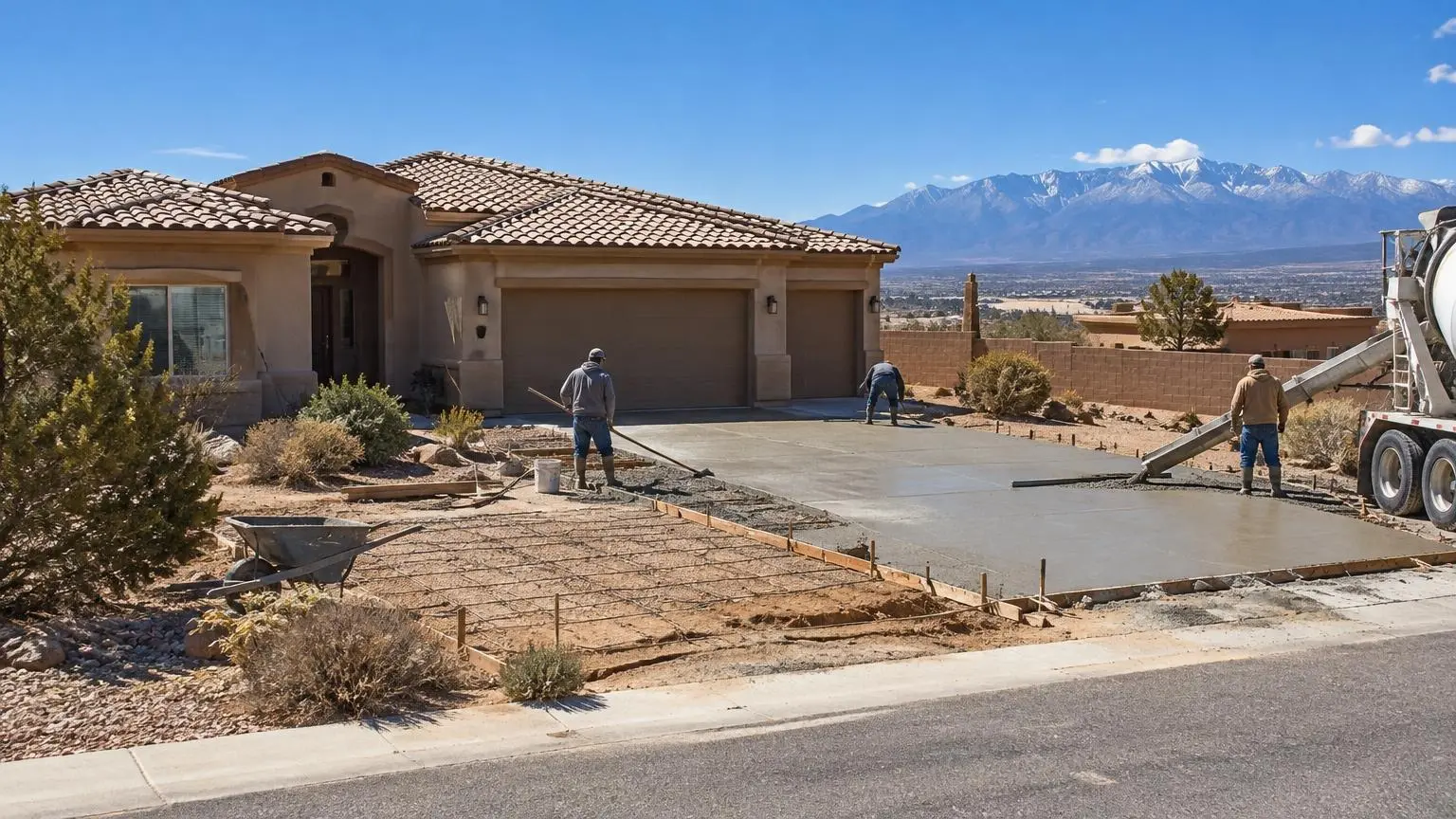
Steps, walks and drives for Queen Anne, Italianate and early 1900s homes east of the railroad.
- Estimate visits start with the ground: grade, runoff and what sits under the old slab
- Quotes broken into lines for area, depth, base, steel, finish and sealer
- Pour dates picked around mesa heat in summer and below-freezing nights in winter
Concrete for Victorian Houses
Huning Highlands is the neighborhood east of the BNSF tracks, bounded by Dr. Martin Luther King Jr. Avenue, Locust Street and Iron Avenue, and it is one of the places where concrete contractors have to fit the work to the house. Huning's Highland Addition was platted in 1880 as the first subdivision added to the original townsite. It built up mainly between the 1880s and the 1920s and was almost fully developed by then.
A historic overlay with real rules
Huning Highlands is different from most neighborhoods in one important way. In 1980 the Albuquerque City Council approved the city's first Historic Overlay Zone here, and according to Wikipedia, alterations to contributing properties require approval from the Landmarks and Urban Conservation Commission. The district has been on the National Register since 1978.
That means a new front walk, a widened driveway or replaced entry steps on a contributing house may need review before work starts. We check your property's status, and if approval is needed, we give you dimensions, materials and finish details to submit. We would rather wait for an approval than pour something you have to tear out.
Styles that drive the details
The neighborhood is known for Queen Anne, Italianate and other Victorian houses alongside early twentieth-century designs, many mixing trim and details from more than one style. The oldest known house in the district, the Horner House on Arno Street, dates to 1881.
Concrete around houses like these should be quiet. We suggest:
- Walks at the original width, often narrower than modern ones
- Steps that match the porch, with the same rise and tread depth as the original
- Simple finishes: broom or hand-troweled, with tooled edges
- Muted color so new concrete does not glare next to old brick and wood
A neighborhood brought back
By the 1970s Huning Highlands had become mostly absentee-owned rentals. Restoration turned that around: the share of blighted or substandard properties fell from 52 percent in 1976 to 17 percent in 1986 and below 5 percent by 2005, and tax incentives are available for restoration. Many owners here are still working through their houses, and the concrete is often one of the last pieces. Original walks may be cracked, heaved by trees or patched many times.
What lies under old walks
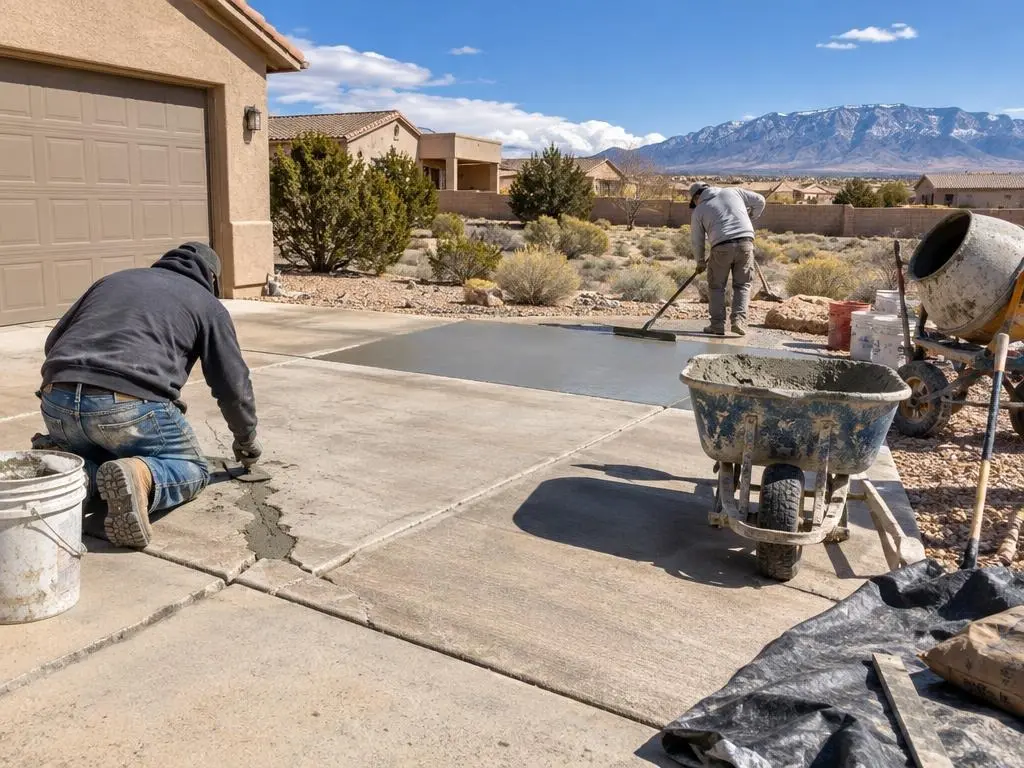
Concrete poured a century ago was often thin and sat on whatever was there. When we remove it, we may find old brick, cinders or loose fill. We take that out, compact a proper gravel base and pour new concrete at the right thickness, with joints in the right places. Done that way, a new walk should outlast the old one by a long margin.
Driveways and alleys
Many lots here were laid out before cars, so driveways are narrow, shared or reached from an alley. Widening one may affect the historic look of the property and may need review. Parking pads off an alley are often an easier option. We look at what fits your lot and the overlay rules before suggesting a plan.
Small-scale work welcome
A single step, a short run of walk, a threshold at the back door: these are normal jobs in a neighborhood like this. We price them fairly and give them the same care as a full driveway.
Trees on the parkway
Mature street trees are part of what makes Huning Highlands pleasant, and they are also the reason many of its walks have lifted. Roots look for water and air, and the gap under a thin old slab gives them both. When we replace a walk near a big tree, we avoid cutting major roots where we can, sometimes route the new walk slightly differently, and may suggest a root barrier. If a tree is on the public parkway, work near it may involve the city, and we check before cutting anything.
Huning Highlands History
- First subdivision. Huning's Highland Addition was platted in 1880 as the first subdivision added to Albuquerque's original townsite.
- Historic overlay. In 1980 the city approved its first Historic Overlay Zone here; changes to contributing properties need Landmarks and Urban Conservation Commission approval.
- Victorian architecture. Queen Anne, Italianate and other Victorian houses plus early 1900s designs; the Horner House on Arno Street dates to 1881.
- Restoration. Blighted or substandard properties fell from 52% in 1976 to under 5% by 2005.
Our Services in Huning Highlands, NM
Huning Highlands Questions
Do I need approval to replace my front walk in Huning Highlands?
If your house is a contributing property in the overlay zone, alterations can require Landmarks and Urban Conservation Commission approval. We check your property and give you what you need to apply.
Can new steps match my Victorian porch?
Yes. We match the original rise, tread depth and width, and use a simple finish that fits the house.
Is it cheaper to patch my old walk again?
In the short term, yes. But if the old concrete is thin and sitting on poor fill, patches keep failing. A properly based replacement often costs less over time.
Free Estimates in Huning Highlands, NM
Free estimates for Huning Highlands homes, with historic review in mind.
Concrete Contractors Near Huning Highlands
- Concrete Contractors in Rio Rancho, NM
- Concrete Contractors in Corrales, NM
- Concrete Contractors in Bernalillo, NM
- Concrete Contractors in Albuquerque, NM
- Concrete Contractors in Placitas, NM
- Concrete Contractors in Los Ranchos de Albuquerque, NM
- Concrete Contractors in North Valley, NM
- Concrete Contractors in Paradise Hills, NM
- Concrete Contractors in Sandia Heights, NM
- Concrete Contractors in West Mesa, NM
- Concrete Contractors in Nob Hill, NM
- Concrete Contractors in Old Town Albuquerque, NM
- Concrete Contractors in Downtown Albuquerque, NM
- Concrete Contractors in Barelas, NM
- Concrete Contractors in South Valley, NM
- Concrete Contractors in Fourth Ward, NM
- Concrete Contractors in International District, NM
- Concrete Contractors in Mesa del Sol, NM
- Concrete Contractors in Algodones, NM