
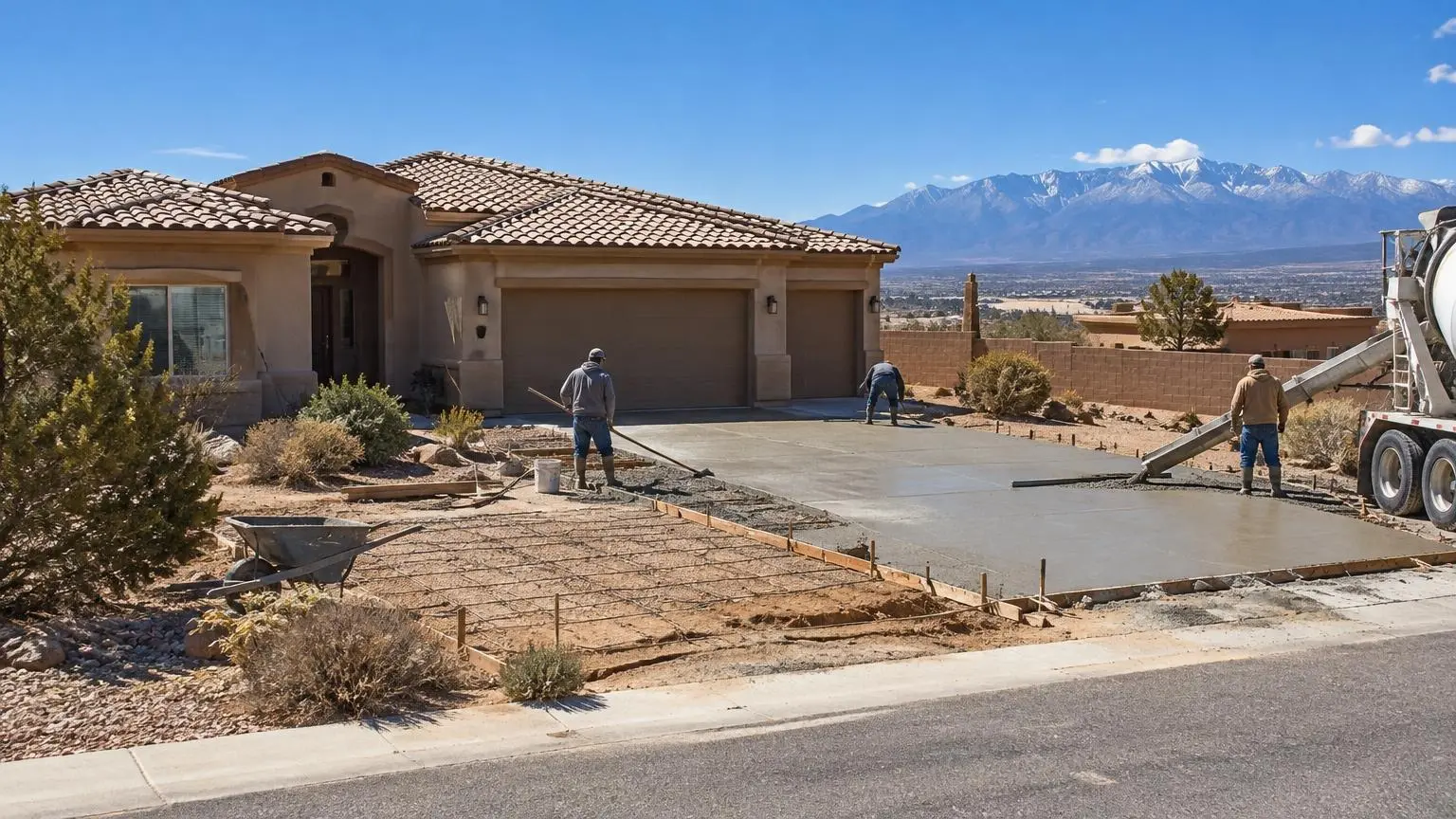
Between 93 and 126 freezing days a year
Concrete Contractors in Albuquerque, NM
One city, a 1,200-foot climb from the river to the foothills, and concrete that has to handle both ends of it.
- Estimate visits start with the ground: grade, runoff and what sits under the old slab
- Quotes broken into lines for area, depth, base, steel, finish and sealer
- Pour dates picked around mesa heat in summer and below-freezing nights in winter
Albuquerque Concrete by Elevation and Era
Albuquerque is the big city on our southern border, and for concrete contractors it is really several cities stacked on a slope. Wikipedia gives the city's elevation as about 4,949 feet near the Rio Grande and about 6,165 feet in the Sandia foothills. The 2020 census counted 564,559 residents in 229,701 households. Between the river valley, the West Mesa and the Northeast Heights, the right driveway or patio depends a lot on where you live.
How the city spread
Albuquerque grew fastest in the middle of the twentieth century. Its population went from 35,449 in 1940 to 96,815 in 1950 and 201,189 in 1960. Expansion pushed east into the Northeast Heights, and housing there has kept growing since the late 1950s. West of the river, the West Mesa has filled in with subdivisions over the past few decades.
That means many Albuquerque driveways and walks are 60 or 70 years old, while others were poured in the last decade. Old concrete is often thinner, lacks steel and has heaved or settled at the joints. Newer concrete may be fine structurally but too small for how the family now uses the yard.
Freeze days, monsoon storms and summer heat
Wikipedia's climate section is a good summary of what exterior concrete faces here. The city averages 93 to 126 days a year at or below freezing, but only one to five days when the high stays below freezing. That pattern means a lot of nights below 32 and days above it, which is the freeze-thaw cycle that pops the surface off weak concrete. Precipitation averages 8.84 inches at the Sunport, most of it in the July to early September monsoon, and the city sees 1 to 11 days a year at 100 degrees or more.
The foothills are a different story: 10 to 17 inches of precipitation and about 23.7 inches of snow a year, compared with 7.9 inches at the airport. For a foothills driveway we pay closer attention to air entrainment, slope, and a finish that grips in snow.
Water has always been the issue
After floods in the 1950s, the Arroyo Flood Control Act of 1963 led to a network of concrete diversion channels built by the Army Corps of Engineers in the 1960s and early 1970s. The city learned on a large scale what every homeowner learns on a small one: storm water has to be steered. On a residential lot, that means slopes that move water away from the house, downspouts that discharge past the slab, and no low spots where water can sit and soak into the base.
Soil from one side of town to the other
The West Mesa rises behind a volcanic escarpment, with sandy soils below it. Sand drains well but needs proper compaction before it will support a slab evenly. In the river valley, ground is flatter and older, and drainage is the bigger question. In the foothills, slopes and rock change how we excavate and form. We look at the lot before quoting anything, because a price based on a guess about the ground is not much use to you.
The six services across Albuquerque
Driveways: replacements for aging mid-century drives and widening for modern vehicles.
Patios: extensions off small builder slabs, shaded portales and pads for outdoor kitchens.
Stamped concrete: stone and tile patterns that suit Pueblo Revival and Territorial-style homes.
Sidewalks and walkways: front walks, side paths and entries with steps.
Slabs: shed, workshop and RV pads.
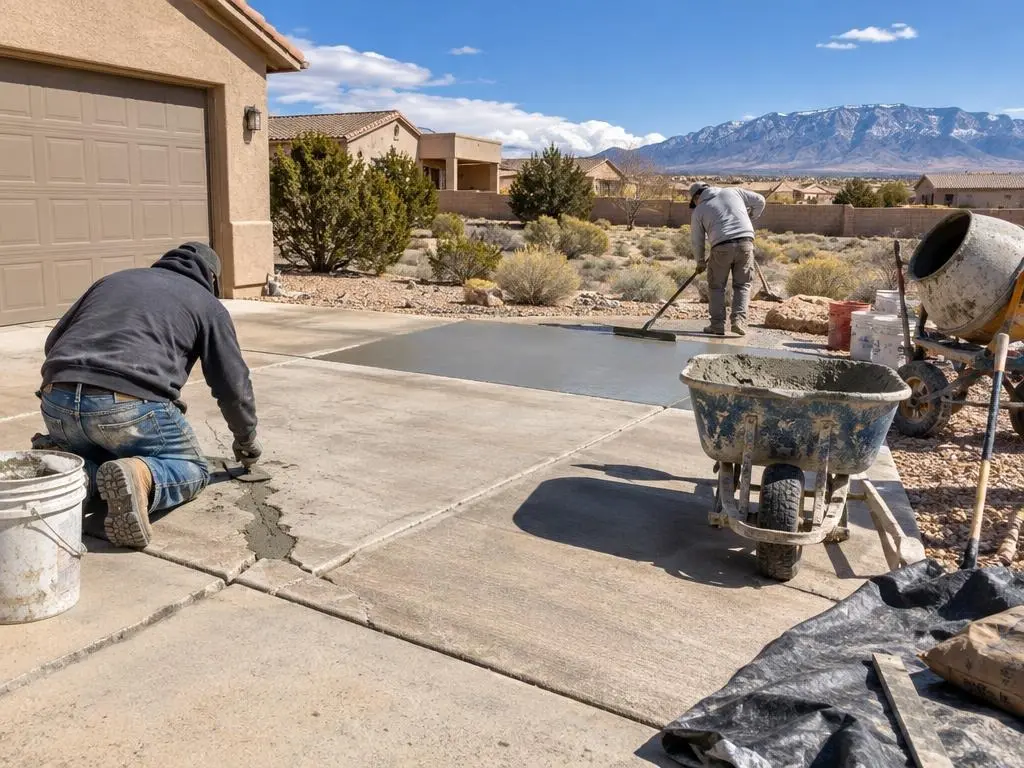
Repair: crack sealing, panel replacement and leveling where the slab is still worth keeping.
Rules depend on where you are
Albuquerque has historic districts, neighborhoods with HOAs and areas just outside city limits under Bernalillo County. Before we schedule work at the street or on a historic property, we confirm what applies to your address.
Albuquerque Conditions for Concrete
- Elevation range. About 4,949 feet near the Rio Grande to 6,165 feet in the Sandia Heights foothills.
- Freeze-thaw. The city averages 93 to 126 days a year at or below freezing, but only 1 to 5 days that stay below freezing all day.
- Foothills snow. The foothills average about 23.7 inches of snow a year, compared with 7.9 inches at the Sunport.
- Mid-century boom. Population grew from 35,449 in 1940 to 201,189 in 1960, as the city expanded into the Northeast Heights.
Our Services in Albuquerque, NM
Albuquerque Questions
Why does concrete flake on the surface in Albuquerque?
Usually freeze-thaw damage. With so many nights below freezing and days above, water in the surface freezes and thaws over and over. Air-entrained concrete, proper curing and a penetrating sealer all help prevent it.
Do you work in the Northeast Heights and the foothills?
Yes. Foothills lots get more snow and have more slope, so we plan drainage, finish texture and forming for those conditions.
Is my 1950s driveway worth repairing?
Sometimes. If it is thin, has no steel and has broken into many pieces, replacement is usually better value. If only a few panels are bad, replacing those sections can work.
Free Estimates in Albuquerque, NM
Free estimates across Albuquerque, from the valley to the foothills.
Concrete Contractors Near Albuquerque
- Concrete Contractors in Rio Rancho, NM
- Concrete Contractors in Corrales, NM
- Concrete Contractors in Bernalillo, NM
- Concrete Contractors in Placitas, NM
- Concrete Contractors in Los Ranchos de Albuquerque, NM
- Concrete Contractors in North Valley, NM
- Concrete Contractors in Paradise Hills, NM
- Concrete Contractors in Sandia Heights, NM
- Concrete Contractors in West Mesa, NM
- Concrete Contractors in Nob Hill, NM
- Concrete Contractors in Old Town Albuquerque, NM
- Concrete Contractors in Downtown Albuquerque, NM
- Concrete Contractors in Barelas, NM
- Concrete Contractors in South Valley, NM
- Concrete Contractors in Huning Highlands, NM
- Concrete Contractors in Fourth Ward, NM
- Concrete Contractors in International District, NM
- Concrete Contractors in Mesa del Sol, NM
- Concrete Contractors in Algodones, NM