
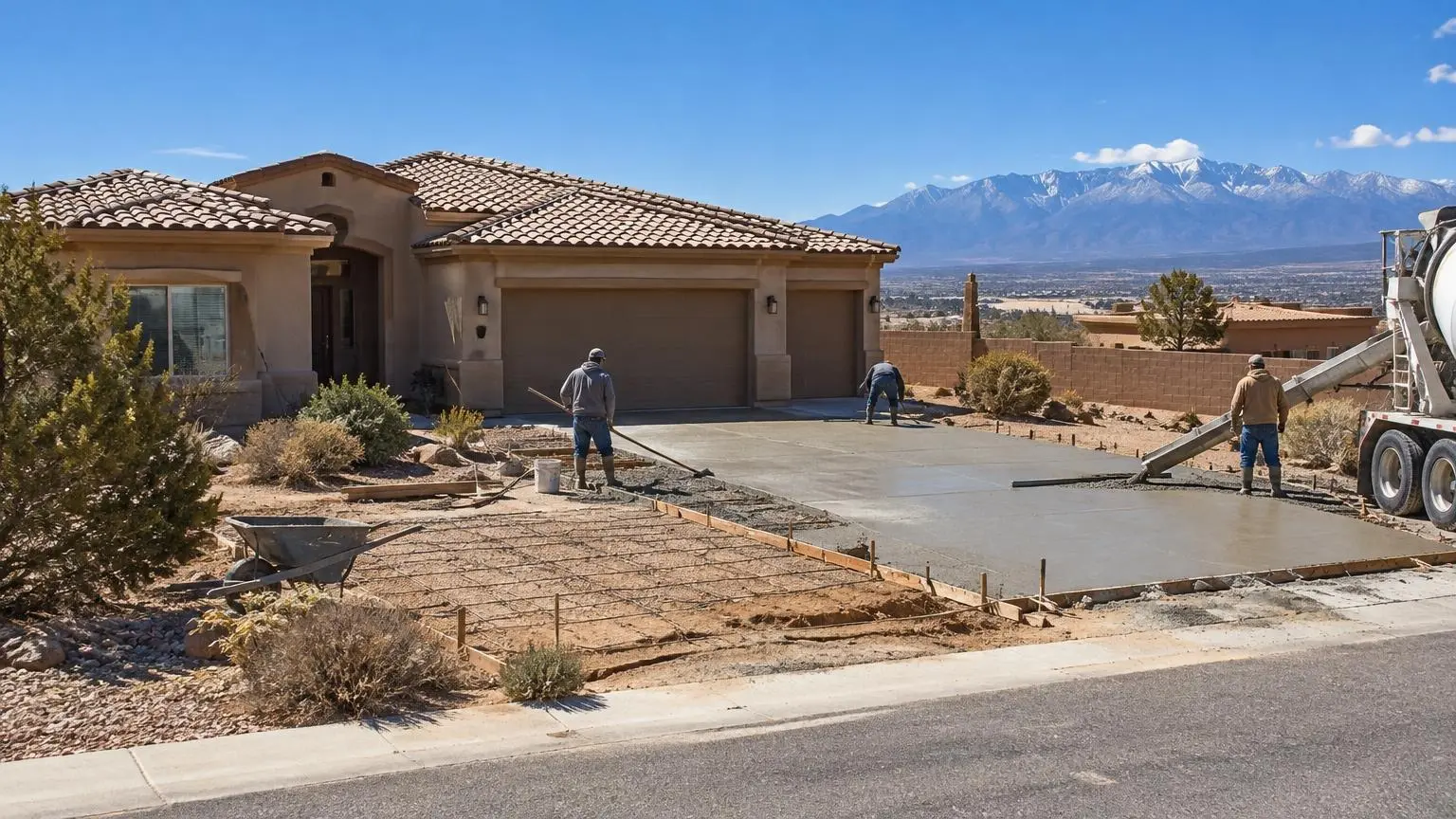
A village of wells, acequias and cottonwoods since 1971
Concrete Contractors in Corrales, NM
Flatwork planned around septic tanks, tree roots and long gravel lanes in a village that has kept its farm character.
- Estimate visits start with the ground: grade, runoff and what sits under the old slab
- Quotes broken into lines for area, depth, base, steel, finish and sealer
- Pour dates picked around mesa heat in summer and below-freezing nights in winter
Pouring Concrete in a Farm Village
Corrales is the village just east of Rio Rancho, squeezed between the city and the Rio Grande, and it asks different things of concrete contractors than the subdivisions next door. Lots are larger, the village is heavily wooded with cottonwoods, and much of it runs on private wells, pumps and leach fields. The village incorporated in 1971 and had 8,493 residents and 3,886 housing units in the 2020 census.
Before the forms go in: what is under the yard
According to the village's Wikipedia entry, much of Corrales has no centralized water or municipal sewer. Homes rely on their own wells, pumps and leach fields, and newer homes may be required to use closed septic systems with a holding tank that has to be pumped on a schedule.
That changes how we plan a driveway or patio. We need to know where the tank, the lines and any leach field sit before we dig. Concrete should not be poured over a leach field, and a slab over a tank lid makes routine service a headache. If your system has a holding tank, the pump truck has to reach it, so the driveway or apron it drives on needs the thickness and base to carry a heavy vehicle. We ask for a septic map if you have one and mark the system before excavation.
Two landscapes in one village
The land in Corrales splits in two. Along the river is a lower riparian zone, heavily wooded with cottonwood and other native trees, with the bosque on the eastern edge. Uphill on the west side it turns into drier, sandy shrubland closer to Rio Rancho.
Near the bosque, the issue is usually trees. Cottonwood roots spread wide and shallow, and they will lift a walkway or crack a patio edge given time. We keep new slabs back from large trunks where we can, and we talk with you about root barriers or a different path route.
On the sandy west side, the issue is support. Loose sand needs proper compaction and a good gravel base, and storm runoff needs a clear path away from the slab.
Cold nights by the river
Corrales runs colder at night than you might expect. Wikipedia's 1991 to 2020 normals for the village put the mean January low at 20.9 degrees, with a record low of minus 11, and an average of 7.7 inches of snow a year. That is plenty of freeze-thaw cycling for exterior concrete. We use air-entrained mixes for outdoor slabs, slope surfaces so water does not sit, and recommend a penetrating sealer once the concrete has cured.
Acequias and irrigation
Canals carry Rio Grande water to fields and pasture here, and Wikipedia notes that the old acequias are still maintained with help from the USDA's Natural Resources Conservation Service and the Middle Rio Grande Conservancy District. If a ditch runs along your property, a driveway crossing or a walkway near the bank needs to be planned with that ditch in mind. Irrigated pasture next to a slab also means wetter ground than the rest of the lot, which is one more reason we build up the base and keep the surface draining away.
Concrete projects that suit Corrales lots
- Paving the first stretch of a long gravel drive, so the area near the garage stays clean in the wet season
- Wide aprons and parking pads for trailers, horse trailers and farm equipment
- Patios and portales under shade trees, with a broom or stamped finish
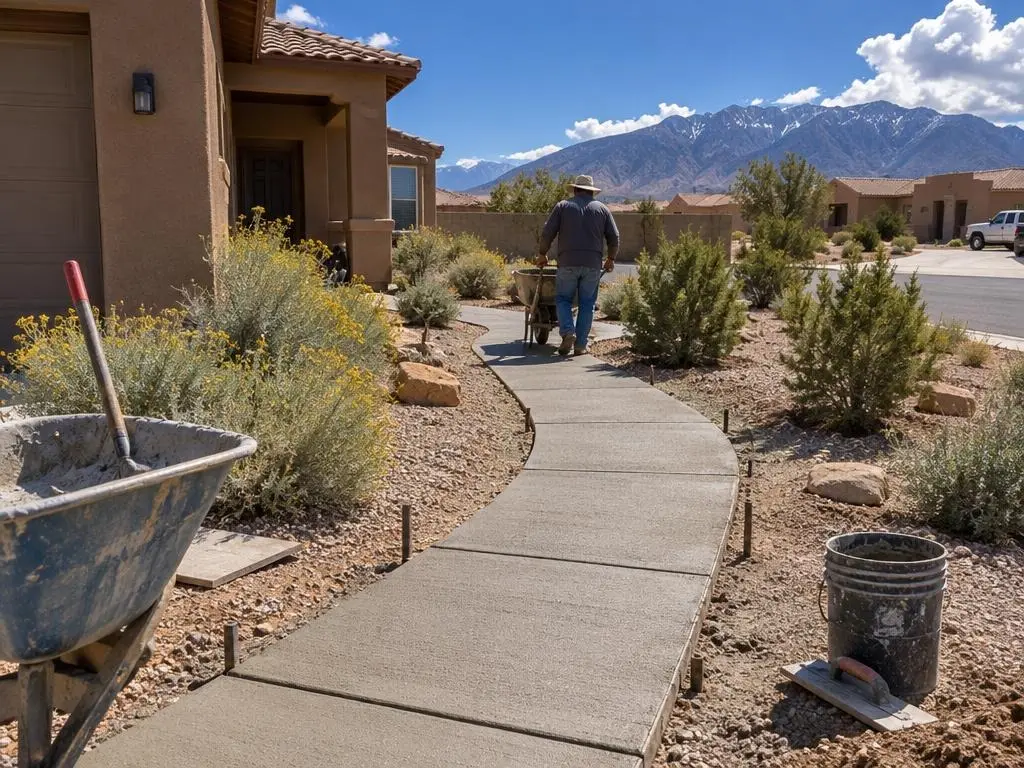
- Walkways between house, barn, studio and garden
- Repair of older slabs lifted by roots or undermined by irrigation water
The village's adobe Church of San Ysidro dates to 1868, and plenty of Corrales homes lean toward earth tones and traditional styles. Integral color or a stamped stone pattern in desert tans tends to sit better here than plain gray.
Corrales Ground Conditions to Know
- Private wells and septic. Much of the village has no central water or sewer, and newer homes may need closed septic systems with a holding tank that is pumped regularly.
- Riparian and sandy zones. Land splits between a wooded lower riparian zone near the bosque and drier, sandy shrubland uphill on the west side.
- Colder winter nights. The 1991-2020 normals list a 20.9 degree mean January low, a record low of -11 and about 7.7 inches of snow a year.
- Steady growth. Population rose from 2,791 in 1980 to 8,493 in 2020; the village incorporated in 1971.
Our Services in Corrales, NM
Corrales Questions
Can you pour a driveway near my septic tank in Corrales?
Yes, as long as we know where it is. We keep concrete off leach fields and plan around tank lids and lines. If a pump truck needs to drive on the slab, we size the thickness and base for that weight.
Will cottonwood roots crack a new patio?
Large cottonwoods can lift concrete over time. We set slabs back from big trunks when possible and discuss root barriers or moving the slab before we pour.
Do I need to pave my whole gravel driveway?
No. Many owners pave only the section near the garage and leave the rest gravel. We build a clean edge where the two meet so the gravel does not undercut the slab.
Free Estimates in Corrales, NM
Free estimates on Corrales properties, from the bosque side to the west mesa edge.
Concrete Contractors Near Corrales
- Concrete Contractors in Rio Rancho, NM
- Concrete Contractors in Bernalillo, NM
- Concrete Contractors in Albuquerque, NM
- Concrete Contractors in Placitas, NM
- Concrete Contractors in Los Ranchos de Albuquerque, NM
- Concrete Contractors in North Valley, NM
- Concrete Contractors in Paradise Hills, NM
- Concrete Contractors in Sandia Heights, NM
- Concrete Contractors in West Mesa, NM
- Concrete Contractors in Nob Hill, NM
- Concrete Contractors in Old Town Albuquerque, NM
- Concrete Contractors in Downtown Albuquerque, NM
- Concrete Contractors in Barelas, NM
- Concrete Contractors in South Valley, NM
- Concrete Contractors in Huning Highlands, NM
- Concrete Contractors in Fourth Ward, NM
- Concrete Contractors in International District, NM
- Concrete Contractors in Mesa del Sol, NM
- Concrete Contractors in Algodones, NM